
MEMBERSHIP
FIRST 3 SESSIONS
To make sure re-enactment is for you, the first three sessions are completely free
This will enable you to get a feel for the hobby and help you decide if you wish to become a full member.
FULL MEMBERSHIP
Full membership covers your insurance up until April, Membership fees are to be renewed every April to keep you insured for training and events
£25
JOIN US!
To enquire about joining us, fill in the form below!
Combat Rules
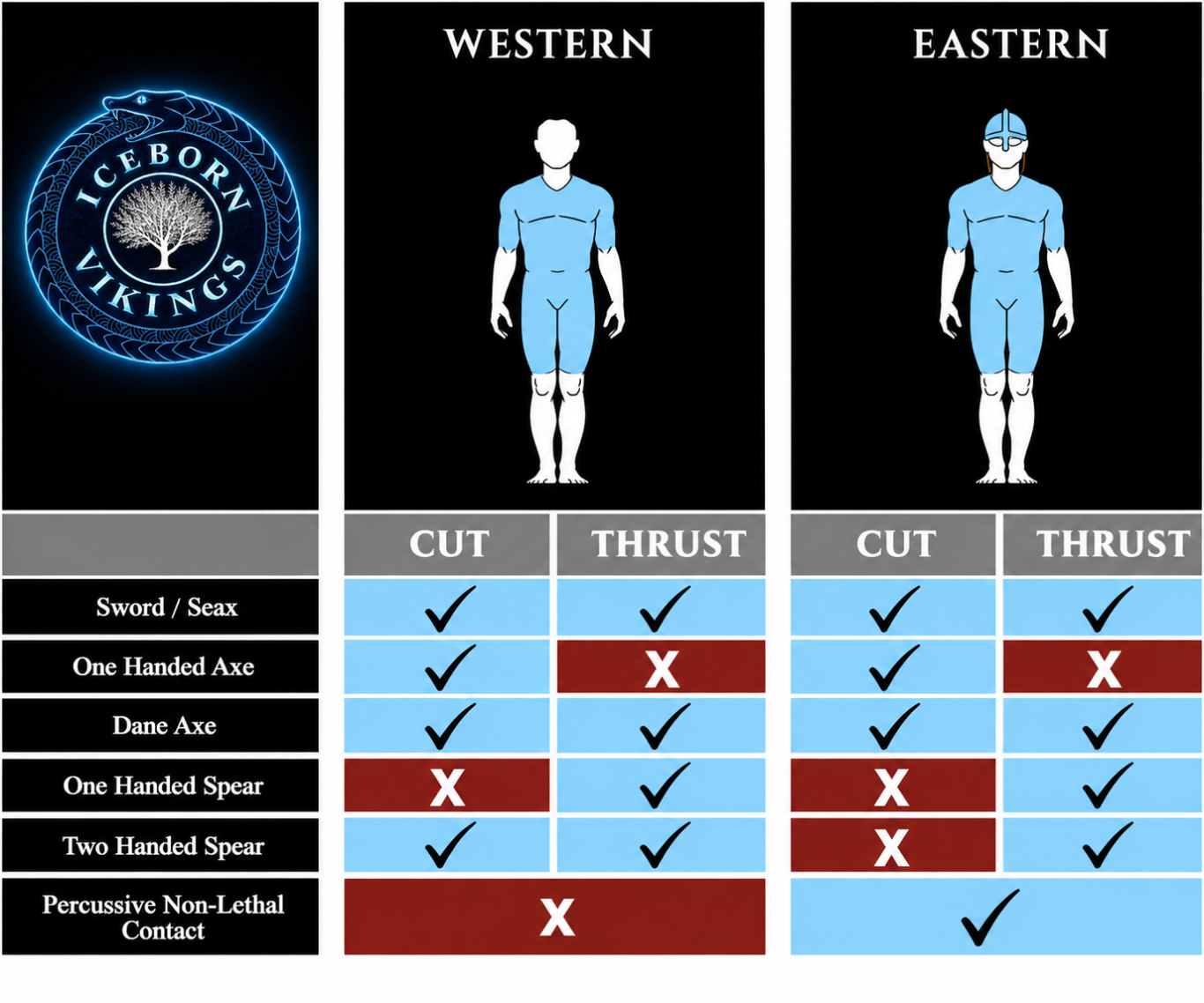
Rules of Engagement by Weapon Type
The chart above outlines our rules of engagement for each weapon type under both Western and Eastern combat styles.
Western combat uses controlled or “pulled” blows, where strikes are moderated to reduce the risk of injury.
Eastern combat allows full-force blows, which naturally increases the potential for injury.
Because of this increased risk, any member participating in Eastern combat is required to wear appropriate protective equipment. This includes, at minimum:
- Approved head protection
- Protective gloves
- Additional protective padding worn under clothing is permitted and encouraged, including but not limited to groin protection.
As a group, we primarily train and perform using Western combat rules. However, our interpretation of Western combat is generally heavier than that used by many other reenactment groups, and participants should expect firm but controlled contact.
Before any member is allowed to train or fight without supervision, they must successfully complete a weapons competency exam to demonstrate safe handling, control, and understanding of the group’s combat standards.
Archery Safety and Combat Rules
Archery will follow Western combat rules at all times. All members must complete archery training before they are permitted to use a bow during combat scenarios.
Combat archery involves both shooting and being shot at with rubber-tipped dowel arrows. Before each battle, all arrows must be inspected to ensure they are safe for use. This includes checking that there are no splinters in the shaft and that the rubber tip is firmly attached.
The dowel directly behind the rubber tip must be flat and never sharp or pointed.
During combat, archers must only aim below the neck (shoulders and lower). This rule is in place to prevent injuries to the neck, head, face, or eyes.
Out of respect for fellow reenactors and to prevent avoidable injuries, do not shoot at anyone who has already fallen in combat.
Hit rules are as follows:
Torso hit: The participant must immediately cease combat and play dead until the battle ends.
Limb hit (arm or leg): The participant may continue fighting but must visibly act injured.
Second hit anywhere on the body: The participant must immediately cease combat and play dead until the end of the battle.
These rules are intended to maintain safety, fairness, and respect among all participants
Conduct and Safety
All Participants are expected to maintain safe weapon control, respect for fellow reenactors and follow instructions of event organizers or combat supervisors at all times. Safety takes priority over competition.
Kit Guidelines
What am I expected to wear at events and training?
Training
At training we recommend trainers or boots as we train outdoors in almost all weathers excluding dangerous weathers such as thunder storms and hail + sports appropriate clothing ie hoody and joggers.
Time Period
The Iceborn Vikings are late Viking Age, so around 900-1066AD. The Viking age is considered to be around 793AD-1066AD, or the raid on Lindisfarne to the Battle of Hastings.
Clothing
See below for detailed men's/women's outfits (terms used for differentiating between these two generic costumes, in practice anyone can wear either costume. We generally encourage anyone enaging in combat to wear the "male" costume for safety reasons (not tripping up on long skirts). Clothing was generally wool or linen.
We reenact a common viking encampment so we tend to aim for as much accuracy as possible so there are different ranks (as there would be back then.)
Thrall (Unfree Viking)
Viking thralls (enslaved people) would have worn clothing in muted, natural, and undyed colours, reflecting their low status and lack of resources for expensive dyes. Their garments, usually made of rough wool or linen, would have been in colors that required little to no processing.
We are probably one of the few groups that don't have thralls.
Karl (Common Viking)
A Common Viking (farmer, laborer, or artisan) in the Viking Age (c. 793–1066 AD) would typically wear clothes in muted, natural, and earthy tones derived from locally available plant dyes and the natural colors of wool. While popular culture often depicts them in drab greys, they likely wore a variety of colors, though they would be less intense, darker, or more muted than those worn by the wealthy.
Everyone in the group will generally be a Karl
Huscarl
A Viking housecarl, as an elite, professional warrior in the service of a king or chieftain, would wear clothing that signaled high status, wealth, and functional, vibrant color. Their attire was not the drab grey and brown often depicted in media, but featured rich, dyed, and often imported fabrics.
We tend to stick to two Huscarls within the group
Jarl
A Viking jarl (noble or chieftain) would wear clothing designed to showcase wealth, status, and power, featuring vibrant, saturated colors that required expensive, imported dyes. Unlike the common, muted, or natural-toned clothes of farmers, a jarl's garments—often made of fine wool or silk—would feature bold colors such as deep blue, scarlet red, yellow, and occasionally purple
In Iceborn Vikings we only have one Jarl
Modern kit - Mobile phones / wallets / medical devices
Where possible please keep modern kit hidden at events. If you have a modern aid - walking stick, glasses, supportive clothing please make one of the council aware and we can work with you to find a solution which "hides" it as best as possible, or encorporates it into your costume somehow. Glasses are ok excluding in combat because of the risk of lenses shattering in the proximity of your eyes risk. That said, for general (low risk) training sessions, many of us do wear glasses.
If you do wish to wear a gumshield during combat (totally optional) please consider opting for a clear version.